Benedict XVI to Consecrate the Sagrada Familia, “Historic Alliance Between Art and Faith”
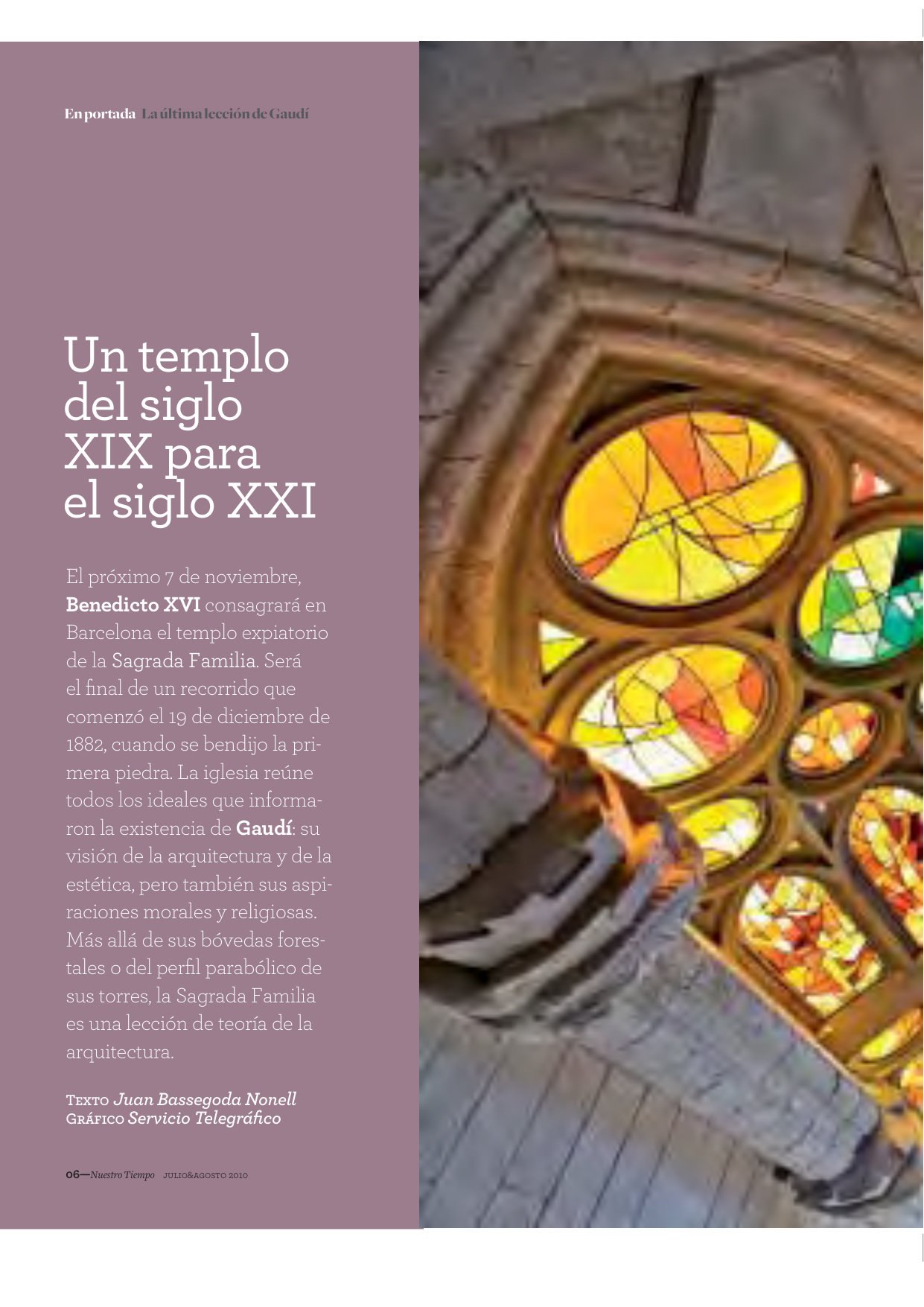
“The church brings together all the ideals that informed Gaudí’s existence: his vision of architecture and aesthetics, but also his moral and religious aspirations.”
On November 7th, Benedict XVI will consecrate the Expiatory Temple of the Sagrada Familia in Barcelona. Cardinal Bertone has affirmed that this event will seal the historic union between faith and art, a supreme manifestation of Gaudí’s mysticism.
The cover document celebrates the imminent consecration of the Expiatory Temple of the Sagrada Familia, scheduled for November 7, 2010, by His Holiness Benedict XVI. This ceremony culminates a journey that began in 1882 with the blessing of the first stone. The work is described as the ultimate expression of Gaudí’s ideals, encompassing his architectural vision, his aesthetics, and his profound moral and religious aspirations.
Cardinal Tarcisio Bertone, Vatican Secretary of State, anticipated in March of that year that the Pope would be ‘marvelled’ by the grandeur of the temple. Bertone emphasized that the official inauguration of the Sagrada Familia will confirm ‘the historic alliance between art and faith,’ a value that Gaudí fully embodied. Gaudí dedicated the last eleven years of his life exclusively to the construction of the temple, even moving in and sleeping in his workshop.
“This simple structural scheme was accompanied by a profound and emotional liturgical sense.”
Gaudí conceived the temple as an ensemble of inclined arborescent columns, seeking a more rational system that would overcome the deficiencies of Gothic architecture. This structural scheme, though simple, was accompanied by a profound and emotional liturgical sense. The architect passionately read the liturgical work of Dom Guéranguer and knew how to confer a deeply religious meaning upon every stone of his temple.
Gaudí’s workshop, where he worked and received his friends and admirers, is remembered as a ‘focal point of religious spirituality’ amidst the turbulent Barcelona of the early twentieth century. The great secret of Gaudian architecture lies in its origin: a careful and intelligent observation of nature, from which he extracted the geometry for his structures. The towers, for example, have a parabolic profile and will house tubular bells arranged like a carillon.
“The Sagrada Familia is a lesson in architectural theory.”
The Sagrada Familia is, ultimately, a ‘condensation of Christian history’ and a lesson in architectural theory. It is considered a continuous and irreversible process, impervious to passing trends, offering an open field for architectural experimentation. Juan Bassegoda Nonell concludes that the work, Gaudí’s pantheon, remains a source of ingenious constructive solutions and an enduring lesson.