Interview: Almuzara Presents His Book “Gaudí, the Architect of the Soul”
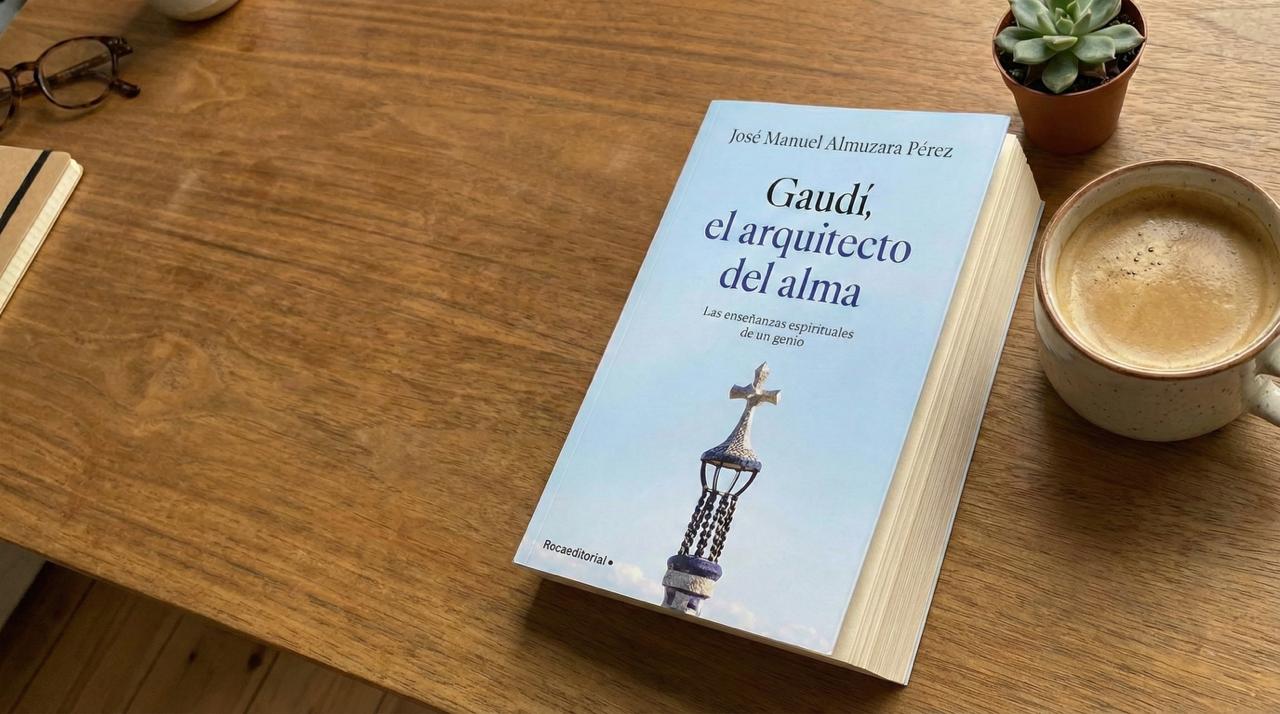
“A book that aspires to be much more than a biography: it is an almost mystical approach between the architect of the soul and the souls of those whom he ceaselessly inspires.”
El Faro de Melilla interviews José Manuel Almuzara, author of "Gaudí, the Architect of the Soul." The writer explains how the life and work of the Catalan genius constitute a path of faith and transformation that continues to attract multitudes.
The essay delves into the coherence between Gaudí’s personal piety and his artistic legacy.
The newspaper El Faro de Melilla has published an interview with José Manuel Almuzara, an expert on the work of Antoni Gaudí and author of the recent essay “Gaudí, the Architect of the Soul.” Almuzara emphasizes that the book is not a biography, but a prose text dedicated to analyzing and interpreting Gaudí’s thought. The objective is to show how his life and work have touched and transformed the souls of countless people throughout time. The author, knowledgeable about Gaudí’s figure, casts his gaze toward the present, focusing on those who remain fascinated by the architect today.
Almuzara describes the book as a “journey through the transformative imprint” that Gaudí left on the world, an experience he himself has lived firsthand. The author emphasizes the total fusion between the architect’s life and work, stressing that Gaudí was consistent with his personal, social, cultural, and religious beliefs. He viewed himself as an instrument and collaborator in the divine creation, putting the gifts he received into practice.
“Life is love and love is sacrifice. Sacrifice is the only thing truly fruitful.”
Gaudí intensely practiced the virtues and a life of piety, considering life a “battle” that requires strength, sustained by spiritual cultivation and religious practices. Being aware of this reality, he frequently received the sacraments, maintained spiritual direction, prayed the Rosary, and undertook severe penances. This external growth (professional experience) and internal growth (personal relationship with God) imprinted a special character on his works, uniting architecture and symbolism, art and faith.
The fascination Gaudí exerts is universal, attracting all types of people, races, and religions, and leading them toward Beauty, which he defined as “the splendor of Truth, and since art is Beauty, without Truth there is no art.” As an example of this transformative impact, Almuzara cites a 1998 letter from a South Korean executive who, after visiting the Sagrada Familia, felt compelled to bow his head before its solemnity and became convinced “of the existence of God.”
“Through Gaudí’s works, and the divine touch they possess, I became convinced of the existence of God.”
A literature professional, commenting on the book, highlighted that Almuzara even addresses Gaudí’s “process of sanctification,” constructing a coherent and faithful narrative. The reading helps deepen the relationship between beauty, interiority, and meaning, understanding the work not only as a result but as a path. The book is recommended to all those who, possessing a capacity for wonder, wish to discover beauty, the essential, and what is truly worthwhile through the architect of the soul.