Radio Interview
"Gaudí, a man who devoted his life and his work to the exaltation of the faith, who set an example in the day-to-day of his life and who left a mark of eternity on his works, deserves to be presented to believers as an example and to non-believers as a subject for reflection."
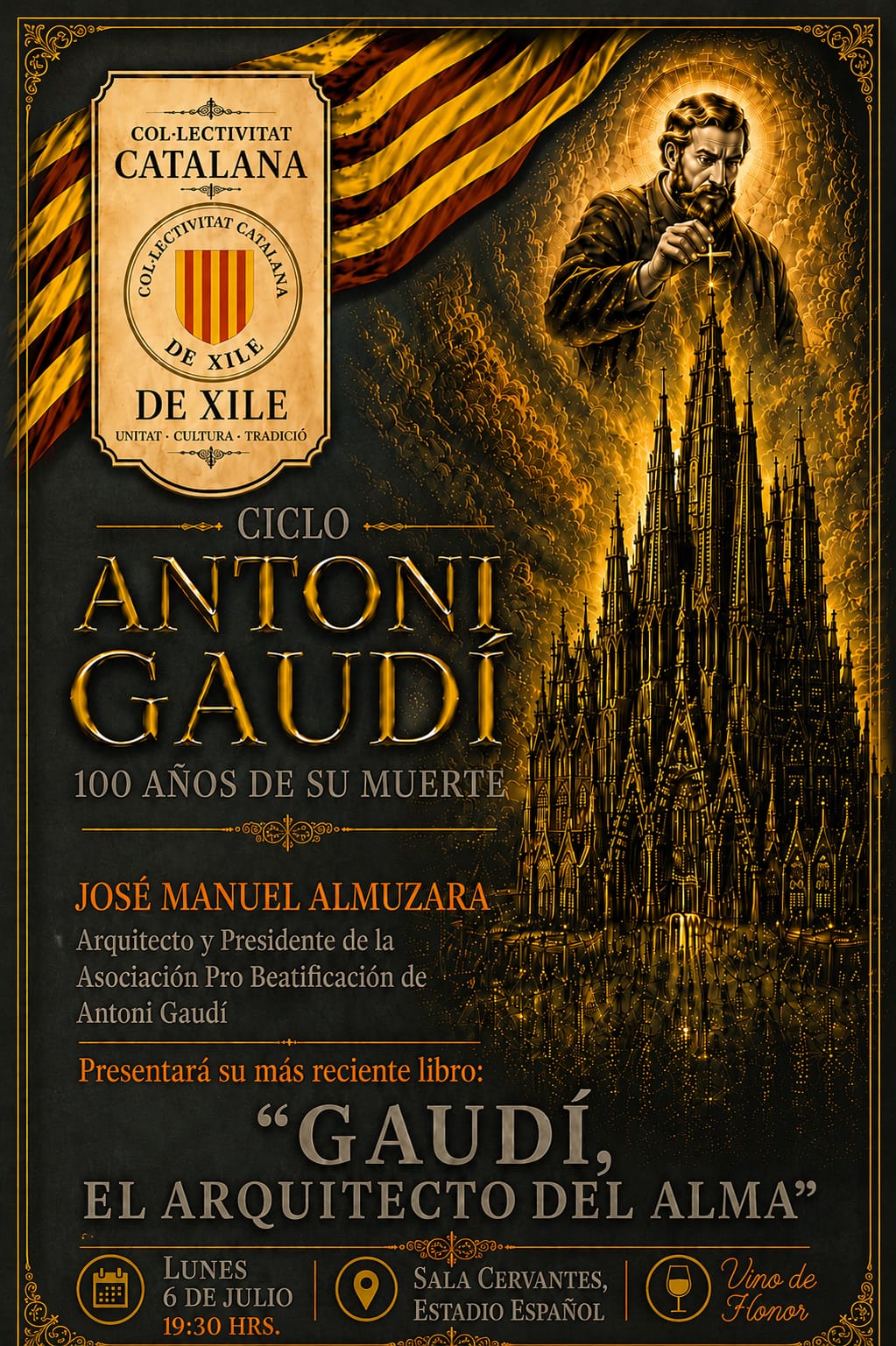
The Col·lectivitat Catalana de Xile invited José Manuel Almuzara to its series «Antoni Gaudí — 100 Years Since His Death», held on 6 July 2026 at the Sala Cervantes of the Estadio Español, in Las Condes (Santiago de Chile). The architect presented his book «Gaudí, el arquitecto del alma» and delivered an address in Catalan on the faith that sustained Gaudí's life and work. The evening began at 7.30 p.m. and closed with a wine reception.
On Monday 6 July 2026, at 7.30 p.m., the Sala Cervantes of the Estadio Español, in the Las Condes district of Santiago de Chile, hosted a new session of the series «Antoni Gaudí — 100 Years Since His Death», organised by the Col·lectivitat Catalana de Xile. The guest was José Manuel Almuzara, architect and, since 1992, president of the Association for the Beatification of Antoni Gaudí, who came to present his book «Gaudí, el arquitecto del alma», published by Roca Editorial in 2026. The gathering brought together the Catalan community living in Chile around the figure of the architect in the year of the centenary of his death. A wine reception was offered to those present once the talk had ended.
Almuzara delivered his address in Catalan, the language of the community hosting him, and opened it with the statement that sums up the meaning of all his work of dissemination: Gaudí devoted his life and his work to the exaltation of the faith, set an example in his daily life and left a mark of eternity on his works, and therefore deserves to be presented to believers as an example and to non-believers as a subject for reflection. That double audience —believers and non-believers— is the key with which he approaches the man in «Gaudí, el arquitecto del alma». The essay offers a personal, reflective reading of the man, the architect and the Christian.
"Gaudí was in love with his work, with a growing personal demand that he passed on to his collaborators; he sought perfection, beauty, collaboration with the Creator, in a word, the glory of God."
Before the Santiago audience, Almuzara described a Gaudí in love with his work, whose growing personal demands he passed on to his collaborators and who sought perfection, beauty and collaboration with the Creator. To illustrate this he recalled the architect's own words on the way work was done on site: «Work is the fruit of collaboration, and collaboration can only be based on love». Gaudí held that an architect must know how to draw on what his workmen know how to do and are able to do, integrating and adding up every effort and lending a hand when they get stuck, «so that they work happily and with the security that comes from full confidence in the organiser». And he added a conviction that Almuzara always underlines: no one is useless, everyone is of service, though not all with the same ability; the question is to find what each one is good for.
The second part of the address dwelt on sacrifice and on the life of piety. Almuzara recalled Gaudí's dictum «Life is love and love is sacrifice. Sacrifice is the only truly fruitful thing», and his conviction that the spiritual and material progress of religious orders and of homes springs from all their members sacrificing themselves for the good of the whole. Along the same lines he cited his defence of bodily exercise and of sobriety in eating, drinking and sleeping as mortifications of the body. «Life is a battle, and to fight one needs strength, and strength is virtue», the architect used to say, a virtue that is only sustained and increased through spiritual cultivation, that is, through religious practice. Aware of this reality, Gaudí frequented the sacraments, had a spiritual director, prayed the rosary, read the Gospel, visited the sick, gave alms and submitted himself to severe penances.
"He impressed on his works a special, striking character that has drawn and still draws the attention of many, uniting Love and Architecture."
The closing brought together the two forms of growth that, for Almuzara, explain his architecture: the outward one —greater professional experience and greater knowledge of technique and materials— and the inward one, an ever deeper personal relationship with God. From both springs that special, striking character which has drawn and still draws the attention of many, uniting Love and Architecture. It is also the argument that underpins the cause of beatification which Almuzara has promoted since he co-founded the Association for the Beatification of Antoni Gaudí in 1992: the holiness of an ordinary life placed at God's service through one's craft. The session of the Col·lectivitat Catalana de Xile thus joined the international programme marking the centenary of the architect's death, with a message Almuzara repeats in every forum: without Gaudí's faith, his work cannot be understood.