Radio Interview
"There is too much interest in consuming his figure as a quick and profitable icon"
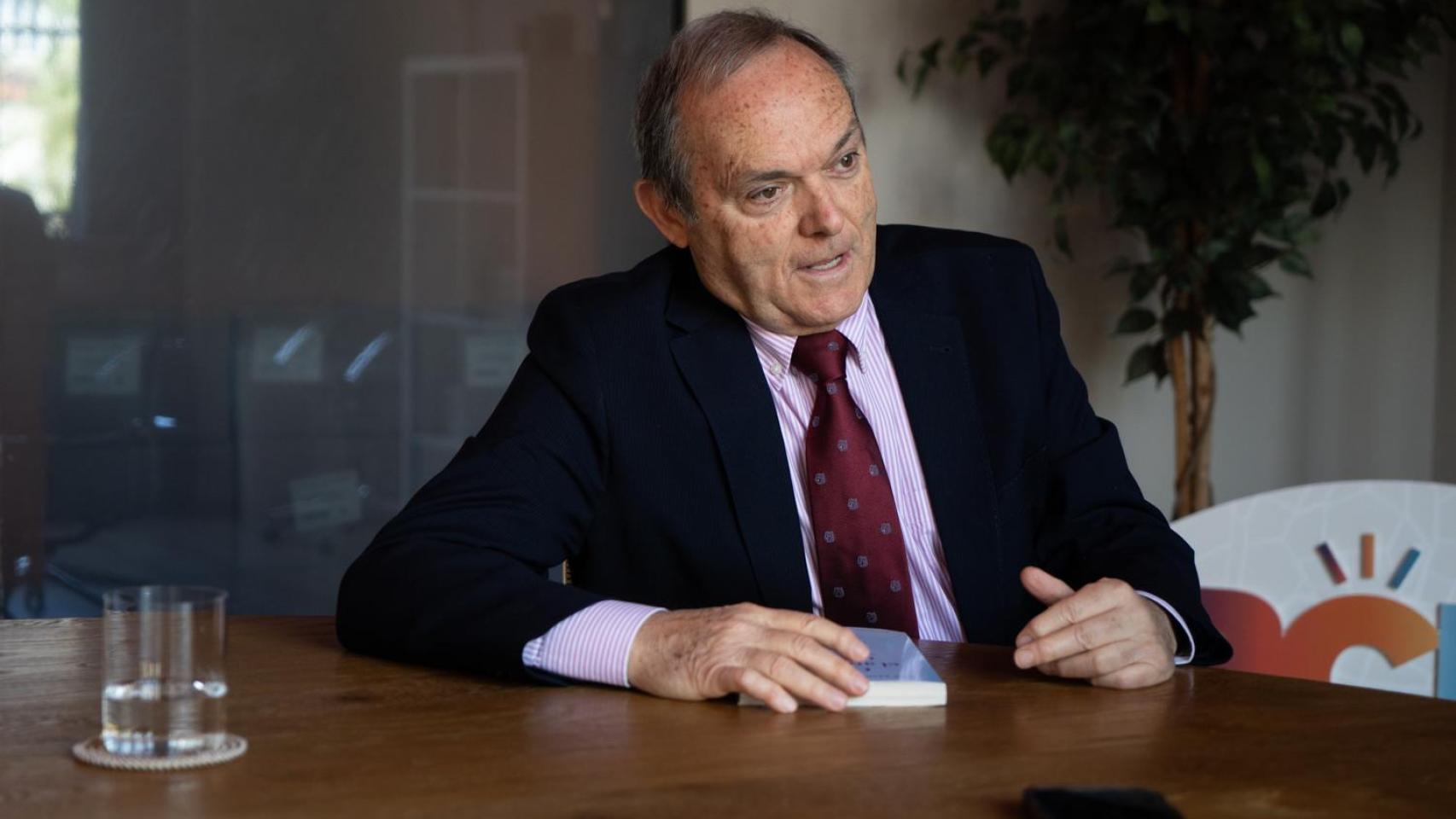
In the middle of the Gaudí Year, Metrópoli Abierta, of the El Español group, interviewed José Manuel Almuzara in Barcelona. The president of the Association for the Beatification of Antoni Gaudí welcomes the attention the architect is receiving, yet warns against reducing him to a tourist icon and reclaims the Sagrada Família as a space of worship and of encounter with God.
On 4 April 2026, Metrópoli Abierta, part of the El Español group, published an interview with José Manuel Almuzara conducted in Barcelona, in the middle of the Gaudí Year. Born in Nador (Morocco) in 1952, Almuzara began his career as an architect in 1977 and has since devoted his work to the work of Antoni Gaudí. He has presided over the Association for the Beatification of Antoni Gaudí since 1992, although since 2023 the canonical side of the cause has rested with an association under the Archdiocese of Barcelona. His public work revolves around a single idea: that Gaudí cannot be understood merely as a great creator of forms, but as a man of faith whose architecture aspired to lift up whoever contemplates it.
In the conversation, Almuzara welcomes the fact that the architect's work is once again at the centre of the cultural map in a year of exhibitions, conferences and publications, but he warns against superficiality. "I am concerned that the interest may be reduced to a passing celebration," he notes, criticising the "excessive tendency to consume the figure of Gaudí as a quick and profitable icon". Against that he calls for "going to the heart of his work and his thought in order to discover Gaudí the man and the Christian". His book «Gaudí, el arquitecto del alma» (Gaudí, the Architect of the Soul; Roca Editorial) was born of that will to endure rather than of passing opportunism: in it he argues that "Gaudí can touch your heart and your soul".
"The temple was conceived as a space of worship, of elevation and of encounter with God, not as mere urban spectacle"
The architect insists that Gaudí's legacy reaches far beyond Barcelona and extends to León, Astorga, Comillas and Mallorca. "Wherever one of his buildings stands, a singular attraction is generated, because the visitor does not find merely a monument, but something unrepeatable," he maintains. Almuzara identifies Gaudí's bond with nature as one of the keys to his universal success, and from there he explains the welcome he receives among Eastern sensibilities, which recognise in his work "an attitude of contemplation and natural harmony". The architect translated into architecture "living, organic forms, closely tied to the natural world".
It is at the Sagrada Família that, in his judgement, the reception of Gaudí has been most strained. The disparagements that have branded the temple a "pastiche" or a "mona de Pascua" (an Easter cake) "arise from not penetrating the meaning of the work", he replies: "Very often only the outward appearance is judged, without asking what each element means. Gaudí placed nothing arbitrarily." What worries him most is the drift towards the "theme park": if the basilica is reduced to a tourist icon and a place for the selfie, "its very reason for being will be betrayed". Of additions such as the illuminated star or the future viewpoint in the tower of Jesus Christ he acknowledges the appeal, but considers them "secondary aspects, not essential ones", and fears that the visit may turn into a "race for the photograph".
"I prefer a pedagogy of wonder and contemplation; for me the ground floor and the crypt are enough"
Almuzara argues that the continuation of the works must respect the general order Gaudí left defined —three façades and not four, eighteen towers and no more— and recalls that the architect "acted with strategic intelligence" by raising the Nativity façade first, knowing that he would not see the temple finished. He further clarifies that "finishing" the basilica is no simple idea: chapels would still be missing —of the seven planned, only three would be complete—, along with cloister chapels and secondary entrances, because "the monumental completion of the great volume is not equivalent to the integral consummation of Gaudí's programme". In 2025, the year the first piece of the cross of the tower of Jesus Christ was set in place, the temple broke its historic record with 4,877,567 visitors. Faced with those figures, the man who has driven the architect's cause of beatification since 1992 once again stresses what he considers essential: a temple raised for worship and for the encounter with God.